Showing posts with label Microbes. Show all posts

Microbes can influence evolution of their hosts

1 Comment
Microbes can influence evolution of their hosts
The tree of life made out of Nasonia microbes. (Robert Brucker/Vanderbilt)

You are not just yourself. You are also the thousands of microbes that you carry. In fact, they represent an invisible majority that may be more you than you realize.
These microscopic fellow travelers are collectively called the microbiome. Realization that every species of plant and animal is accompanied by a distinctive microbiome is old news. But evidence of the impact that these microbes have on their hosts continues to grow rapidly in areas ranging from brain development to digestion to defense against infection to producing bodily odors.
Now, contrary to current scientific understanding, it also appears that our microbial companions play an important role in evolution. A new study, published online on July 18 by the journal Science, has provided direct evidence that these microbes can contribute to the origin of new species by reducing the viability of hybrids produced between males and females of different species.
“It was a high-risk proposition. The expectation in the field was that the origin of species is principally driven by genetic changes in the nucleus. Our study demonstrates that both the nuclear genome and the microbiome must be considered in a unified framework of speciation,” said Associate Professor of Biological Sciences Seth Bordenstein who performed the study with graduate student Robert Brucker.This study provides the strongest evidence to date for the controversial hologenomic theory of evolution, which proposes that the object of Darwin’s natural selection is not just the individual organism as he proposed, but the organism plus its associated microbial community. (The hologenome encompasses the genome of the host and the genomes of its microscopic symbiotes.)
They conducted their research using three species of the jewel wasp Nasonia. These tiny, match-head sized wasps parasitize blowflies and other pest flies, which make them useful for biological control.
Nasonia
Colored scanning electron microscope image of an adult Nasonia female.
(Robert Brucker/Vanderbilt)

“The wasps have a microbiome of 96 different groups of microorganisms,” said Brucker. Two of the species they used (N. giraulti and N. longicornis) only diverged about 400,000 years ago so they are closely related genetically. This closeness is also reflected in their microbiomes, which are quite similar. The third species (N. vitripennis), on the other hand, diverged about a million years ago so there are greater differences in both its genome and microbiome, he explained.
The mortality of hybrid offspring from the two closely related species was relatively low, about 8 percent, while the mortality rate of hybrid offspring between either of them and N. vitripennis was quite high, better than 90 percent, the researchers established.
“The microbiomes of viable hybrids looked extremely similar to those of their parents, but the microbiomes of those that did not survive looked chaotic and totally different,” Brucker reported.
The researchers showed that the incompatibilities that were killing the hybrids had a microbial basis by raising the wasps in a microbe-free environment. They were surprised to find that the germ-free hybrids survived just as well as purebred larvae. But when they gave the germ-free hybrids gut microbes from regular hybrids, their survival rate plummeted.
“Our results move the controversy of hologenomic evolution from an idea to an observed phenomenon,” said Bordenstein. “The question is no longer whether the hologenome exists, but how common it is?”

Article Source : Vanderbilt University.
By Science and universe
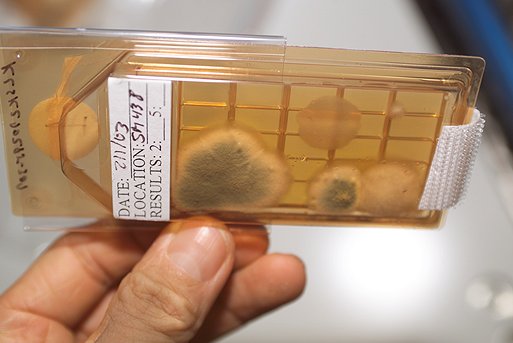
Microbial Creatures in Space

Add Comment
To monitor microbial growth and ensure a safe and healthy environment on the International Space Station, crew members take regular samples of air, surfaces, and water to be analyzed. Scientists' main focus is still to prevent microbes on the station, rather than to remediate. (NASA) 

The microbial ecosystems on the International Space Station are no different. Some microbes were inhabitants from the time the station was assembled. Some join each time a new crew member or payload arrives. People, their habits, their physiological reactions to their emotional states, and their physical environment are all variables that have the potential to continue to alter microbe systems on the space station. With the potential to affect future space exploration missions, researchers funded by NASA's Human Research Program plan to gather and analyze biological samples to study better the space station's Microbiome -- the ever-changing microbe environment that can be found on the space station and its inhabitants. 


Researchers are asking important questions: how might microbes aboard the station impact an astronaut living in space for a year or more? Could an extended period of spaceflight create an influx of disease-causing germs known as pathogens, or affect a crew member's ability to fight off a disease? What would be the potential effects to station hardware or its operation? Could it be a show-stopper for long-duration space travel? The old adage holds true: an ounce of prevention is worth a pound of cure. So, as plans continue toward exploring space further and longer, NASA researchers are looking for answers to these questions and others. 

NASA has a long history of studying the microorganisms that inhabit the closed-environments of spacecraft, such as the study of specific measurable characteristics called microbial biomarkers, which indicate the physiological state of organisms as they are spread among the crew members and their spacecraft environment. Until now, however, NASA has not conducted a systematic, comprehensive study using the latest molecular technology of the microbiome of the crew members or their environment. Among the station's microbes are pathogens that are introduced in a variety of ways. For example, humans naturally carry Staphylococcus aureus (more commonly known as "staph"), so it’s not surprising that this bacterium has been found on surfaces and in the air on the station where crew members live and work. Opportunistic pathogens (such as waterborne bacteria) could cause very serious, sometimes fatal infections. Crew members could serve as hosts, bringing pathogenic viruses aboard the station with them. 

Expedition Six Flight Engineer Don Pettit uses a chemical/microbial analysis bag to collect water samples from the Potable Water Heater in the Zvezda Service Module on the International Space Station. (NASA) 

"We spend a great deal of time and effort to prevent pathogens from getting aboard spacecraft," says Mark Ott, Ph.D., a microbiologist at NASA's Johnson Space Center, Houston. "So, we are definitely interested in possible changes in the types of organisms on spacecraft over time, which result from the crew's exposure to the spaceflight environment." 

A crew member's diminished immune system also can make infection more probable, so precautionary measures are put in place to protect them. Crew members receive medical exams before launch. Water and air aboard the station are filtered, and microbe levels (including on surfaces) are regularly sampled and monitored. Payloads are reviewed to ensure all biohazardous materials are adequately contained, and food lots are carefully analyzed before transport. The host-pathogen relationship aboard the station's environment is pivotal in the battle between health and disease; therefore, it is important that crew members maintain a healthy, robust immune system during their time aboard the space station. In the upcoming Microbiome study, a team of scientists led by Hernan Lorenzi, Ph.D., assistant professor at the J. Craig Venter Institute in Rockville, Md., plans to gather and analyze microbial air, surface and water samples from the station and saliva, blood, skin and perspiration samples from several crew members before, during and after their missions. Crew members will even provide gastrointestinal samples gathered during trips to the bathroom! 

Each bodily sample contains different collections of bacterial species that are likely to be affected by environmental factors associated with space travel. For instance, skin microbes are expected to be more susceptible to space radiation, while the composition of the gut and mouth microorganisms (or flora) may be more affected by changes in an astronaut's diet. Data from these collections will help scientists understand the status of the crew members' microbiome, its interaction with the unique environment of the space station and which environmental factors associated with space travel are most likely to alter the normal composition of the human microbiome. 

There also is intense study of the microbiome by the U.S. and other countries following the finding that it is linked to the state of health in different organs and tissues. Performing this study in the stressful environment of space will allow scientists to determine whether alterations in the crew’s microbiome are harmful to human health. 

For example, do microbes inhabiting the air of the space station end up being part of the astronauts' nose microbiome? And if so, do these newly acquired bacteria pose a potential risk to the crew members' health by displacing beneficial microbes from the nose? Answers gathered from this and other related studies are expected to provide bold new knowledge on the health effects of stress on out health on Earth, and will be critical for developing preventive treatments that diminish the chances of becoming sick during long stays in space. 

Impairment of immune function or introduction of disease from pathogens could have drastic consequences for the safety of the crew members and the success of a mission. The ability to assess the likelihood and consequences of changes in the microbiome due to extreme environments and the related health risks posed to humans also may benefit populations on Earth. This study may provide key factors to expanding our fragile horizon into space, while expanding the knowledge base for how the human body's micro biome functions.

Credit : NASA