Showing posts with label Cassini. Show all posts

Cassini Data: Saturn Moon May Have Rigid Ice Shell

Add Comment
This image of the surface of Saturn's moon Titan was obtained by the European Space Agency's
Huygens Probe on Jan. 14, 2005, after it was delivered to Titan by NASA's Cassini spacecraft.
Image Credit: 
ESA/NASA/JPL/University of Arizona
An analysis of gravity and topography data from the Saturnian moon Titan obtained by NASA's Cassini spacecraft suggests there could be something unexpected about the moon's outer ice shell. The findings, published on Aug. 28 in the journal Nature, suggest that Titan's ice shell could be rigid, and that relatively small topographic features on the surface could be associated with large ice "roots" extending into the underlying ocean.

The study was led by planetary scientists Douglas Hemingway and Francis Nimmo at the University of California, Santa Cruz, who used data from Cassini. The researchers were surprised to find a counterintuitive relationship between gravity and topography.

"Normally, if you fly over a mountain, you expect to see an increase in gravity due to the extra mass of the mountain," said Nimmo, a Cassini participating scientist. "On Titan, when you fly over a mountain, the gravity gets lower. That's a very odd observation."

One potential explanation is that each bump in the topography on the surface of Titan is offset by a deeper "root" that is big enough to overwhelm the gravitational effect of the bump on the surface. The root could act like an iceberg extending below the ice shell into the ocean underneath it. In this model, Cassini would detect less gravity wherever there is a big chunk of ice rather than water because ice is less dense than water.

"It's like a big beach ball under the ice sheet pushing up on it, and the only way to keep it submerged is if the ice sheet is strong," said Hemingway, the paper's lead author and a Cassini team associate. "If large roots under the ice shell are the explanation, this means that Titan's ice shell must have a very thick rigid layer."

If these findings are correct, a thick rigid ice shell makes it very difficult to have ice volcanoes, which some scientists have proposed to explain other features seen on the surface. They also suggest that convection or plate tectonics are not recycling Titan's ice shell, as they do with Earth's geologically active crust.

The Cassini-Huygens mission is a cooperative project of NASA, the European Space Agency, and the Italian Space Agency. The mission is managed by NASA's Jet Propulsion Laboratory, Pasadena, Calif., for NASA's Science Mission Directorate, Washington.

More information on Cassini can be found at http://www.nasa.gov/cassini and http://saturn.jpl.nasa.gov .

Source : NASA
By Science and Universe

NASA Releases Images of Earth by Distant Spacecraft

Add Comment
The Day the Earth Smiled: Sneak Preview
To view full caption and Image Click here
Color and black-and-white images of Earth taken by two NASA interplanetary spacecraft on July 19 show our planet and its moon as bright beacons from millions of miles away in space. 

NASA's Cassini spacecraft captured the color images of Earth and the moon from its perch in the Saturn system nearly 900 million miles (1.5 billion kilometers) away. MESSENGER, the first probe to orbit Mercury, took a black-and-white image from a distance of 61 million miles (98 million kilometers) as part of a campaign to search for natural satellites of the planet. 

In the Cassini images Earth and the moon appear as mere dots -- Earth a pale blue and the moon a stark white, visible between Saturn's rings. It was the first time Cassini's highest-resolution camera captured Earth and its moon as two distinct objects. 

It also marked the first time people on Earth had advance notice their planet's portrait was being taken from interplanetary distances. NASA invited the public to celebrate by finding Saturn in their part of the sky, waving at the ringed planet and sharing pictures over the Internet. More than 20,000 people around the world participated. 

"We can't see individual continents or people in this portrait of Earth, but this pale blue dot is a succinct summary of who we were on July 19," said Linda Spilker, Cassini project scientist, at NASA's Jet Propulsion Laboratory in Pasadena, Calif. "Cassini's picture reminds us how tiny our home planet is in the vastness of space, and also testifies to the ingenuity of the citizens of this tiny planet to send a robotic spacecraft so far away from home to study Saturn and take a look-back photo of Earth." 

Large Image and Caption


Pictures of Earth from the outer solar system are rare because from that distance, Earth appears very close to our sun. A camera's sensitive detectors can be damaged by looking directly at the sun, just as a human being can damage his or her retina by doing the same. Cassini was able to take this image because the sun had temporarily moved behind Saturn from the spacecraft's point of view and most of the light was blocked. 

A wide-angle image of Earth will become part of a multi-image picture, or mosaic, of Saturn's rings, which scientists are assembling. This image is not expected to be available for several weeks because of the time-consuming challenges involved in blending images taken in changing geometry and at 

vastly different light levels, with faint and extraordinarily bright targets side by side. 

Two Views of Home
Large Image and Caption
One Special Day in the Life of Planet Earth
Large Image and Caption


"It thrills me to no end that people all over the world took a break from their normal activities to go outside and celebrate the interplanetary salute between robot and maker that these images represent," said Carolyn Porco, Cassini imaging team lead at the Space Science Institute in Boulder, Colo. "The whole event underscores for me our 'coming of age' as planetary explorers." 

In the MESSENGER image, Earth and the moon are less than a pixel, but appear very large because they are overexposed. Long exposures are required to capture as much light as possible from potentially dim objects. Consequently, bright objects in the field of view become saturated and appear artificially large. 


"That images of our planet have been acquired on a single day from two distant solar system outposts reminds us of this nation's stunning technical accomplishments in planetary exploration," said MESSENGER Principal Investigator Sean Solomon of Columbia University's Lamont-Doherty Earth Observatory in Palisades, N.Y. "And because Mercury and Saturn are such different outcomes of planetary formation and evolution, these two images also highlight what is special about Earth. There's no place like home." 

   
The Cassini-Huygens mission is a cooperative project of NASA, the European Space Agency and the Italian Space Agency. JPL designed, developed and assembled the Cassini orbiter and its two onboard cameras. The Johns Hopkins University Applied Physics Laboratory in Laurel, Md., designed and built MESSENGER, a spacecraft developed under NASA's Discovery Program. NASA's Marshall Space Flight Center in Huntsville, Ala., manages the program for the agency's Science Mission Directorate in Washington. JPL and APL manage their respective missions for NASA. The California Institute of Technology in Pasadena manages JPL for NASA. 

More information about the picture and the Wave at Saturn campaign is available at:http://saturn.jpl.nasa.gov/waveatsaturn . 

To view the MESSENGER images, visit: http://go.nasa.gov/16Vnt5G .


Credit : NASA
By Science and Universe
Present Position

Add Comment


These images show SIMULATED views from the Cassini spacecraft, from several useful points of view which will vary depending on what's happening in the mission. Click on an image to see a full-screen view. These images are updated as circumstances warrant, at least once a day.

Peering Deep into Jupiter's Atmosphere Cassini Spacecraft

Add Comment


Peering Deep into Jupiter's Atmosphere

The dark hot spot in this false-color image from NASA's Cassini spacecraft is a window deep into Jupiter's atmosphere. All around it are layers of higher clouds, with colors indicating which layer of the atmosphere the clouds are in. The bluish clouds to the right are in the upper troposphere, or perhaps higher still, in the stratosphere. The reddish gyre under the hot spot to the right and the large reddish plume at its lower left are in the lower troposphere. In addition, a high, gauzy haze covers part of the frame. An annotated version of this image highlights the hot spot in the middle with an arrow and boxes around the plume and the gyre. 


This image was taken on Dec. 13, 2000, by Cassini's imaging science subsystem. 

The Cassini-Huygens mission is a cooperative project of NASA, the European Space Agency and the Italian Space Agency. The Jet Propulsion Laboratory, a division of the California Institute of Technology in Pasadena, manages the mission for NASA's Science Mission Directorate, Washington. The Cassini orbiter and its two onboard cameras were designed, developed and assembled at JPL. The imaging operations center is based at the Space Science Institute in Boulder, Colo. 

For more information about the Cassini-Huygens mission visit http://www.nasa.gov/cassini and http://saturn.jpl.nasa.gov . 

Image credit: NASA/JPL-Caltech/SSI/GSFC

Video by NASA :


More :

The Equatorial Region (EZ) is one of the more stable regions of the planet, in latitude and in activity. The northern edge of the EZ hosts spectacular plumes that trail southwest from the NEB, which are bounded by dark, warm (in infrared) features known as festoons (hot spots).


Zones, belts and vortices on Jupiter. The wide equatorial zone is visible in the center surrounded by two dark equatorial belts (SEB and NEB). The large grayish-blue irregular "hot spots" at the northern edge of the white Equatorial Zone change over the course of time as they march eastward across the planet. The Great Red Spot is at the southern margin of the SEB. Strings of small storms rotate around northern-hemisphere ovals. Small, very bright features, possible lightning storms, appear quickly and randomly in turbulent regions. The smallest features visible at the equator are about 600 kilometers across. This 14-frame animation spans 24 Jovian days, or about 10 Earth days. The passage of time is accelerated by a factor of 600,000. By Wikipedia


Cassini sheds light on cosmic particle accelerators- ESA

Add Comment
Cassini at Saturn’s bow shock

During encounter with an unusually strong blast of solar wind arriving at Saturn, the international Cassini spacecraft detected that particles are being accelerated to ultra-high energies, similar to the acceleration that takes place around supernova explosions.
Acceleration around supernova explosions
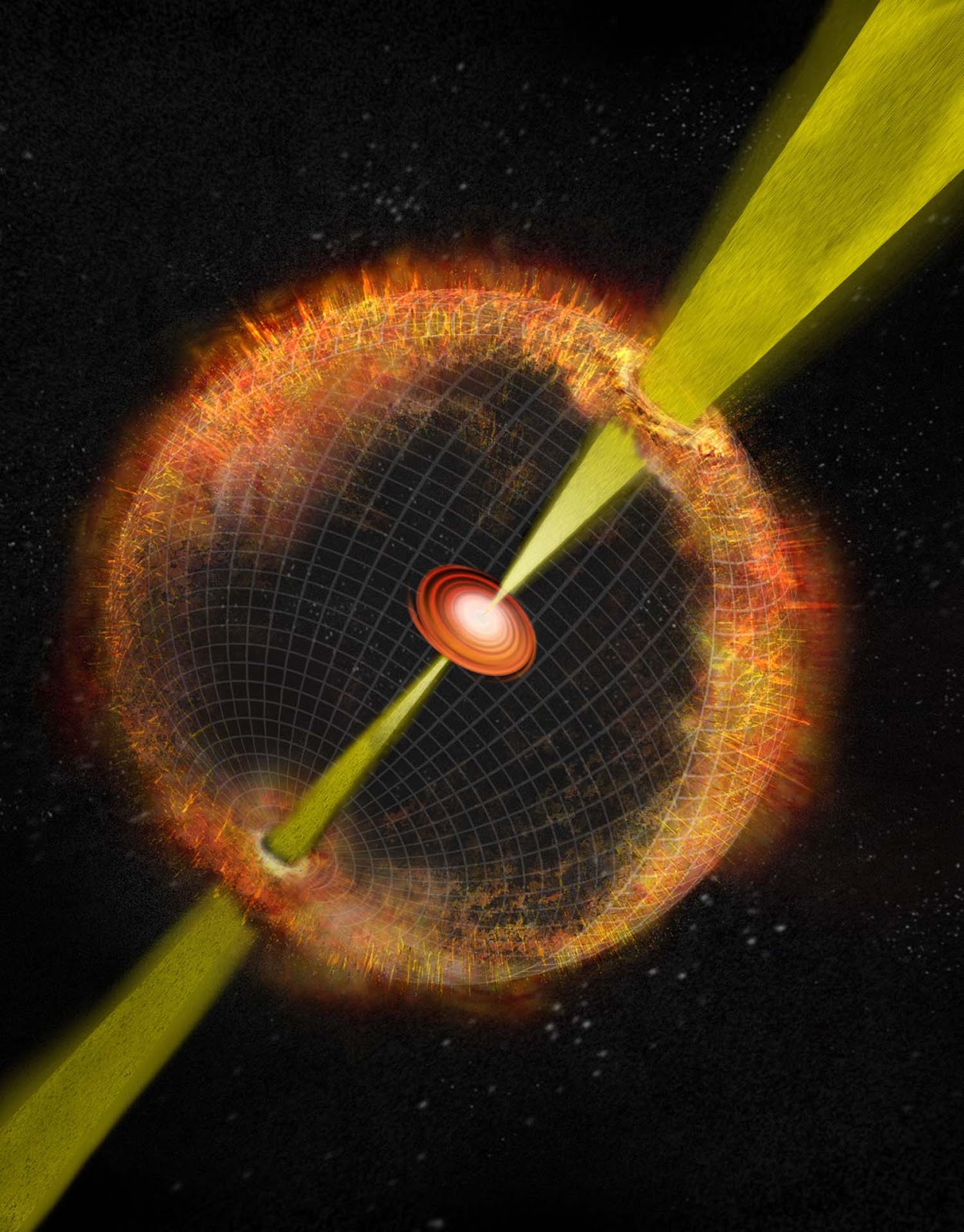
Shock waves are commonplace in the Universe, for example in the aftermath of a stellar explosion as debris accelerates outwards in a supernova remnant, or when the flow of particles from the Sun – the solar wind – impinges on the magnetic field of a planet to form a bow shock.
Under certain magnetic field orientations and depending on the strength of the shock, particles can be accelerated to close to the speed of light at these boundaries. Indeed, very strong shocks at young supernova remnants are known to boost electrons to ultra-relativistic energies, and may be the dominant source of cosmic rays, high-energy particles that pervade our Galaxy.
 Accelerated electrons at supernova remnant shocks is X-ray emission is reveled by Space telescopes , but these observations are made at great distances and thus the orientation of the local magnetic field can only be poorly measured at best. Without this crucial information, it is difficult to gain a full understanding of the shock acceleration process.