Showing posts with label Galaxies. Show all posts

A Fluffy Disk Around a Baby Star

Add Comment

Artist’s rendition of the "fluffy" layer associated with the protoplanetary disk of RY Tau, including jets coming from the star. Although typical young stars like RY Tau are often associated with jets, they are not visible in the HiCIAO observations at this time. (Credit: NAOJ)
An international team of astronomers that are members of the Strategic Exploration of Exoplanets and Disks with Subaru Telescope (SEEDS) Project has used Subaru Telescope's High Contrast Instrument for the Subaru Next Generation Adaptive Optics (HiCIAO) to observe a disk around the young star RY Tau (Tauri). The team's analysis of the disk shows that a "fluffy" layer above it is responsible for the scattered light observed in the infrared image. Detailed comparisons with computer simulations of scattered light from the disk reveal that this layer appears to be a remnant of material from an earlier phase of stellar and disk development, when dust and gas were falling onto the disk.


(left) An image in the near infrared (1.65 μm) around RY Tau, using a special mode of the HiCIAO coronagraph, the polarized intensity image. This type of observation is preferred for faint emissions associated with scattered light around planet-forming disks, as there is less light from the much brighter star. The colors indicate the strength of the emission (blue, yellow and red from faint to bright). A coronagraphic mask in the telescope optics blocks the central star, with its position marked at the center. A white ellipse shows the position of the midplane of the disk, which is observed at millimeter wavelengths. Scattered light observed in the near infrared is offset to the top of the image compared with the denser millimeter disk. (right) Schematic view of the observed infrared light. The light from the star is scattered in the upper dust layer, and it makes the observed light offset from the midplane. (Credit: NAOJ)
Since 2009, the five-year SEEDS Project (Note) has focused on direct imaging of exoplanets, i.e., planets orbiting stars outside of our Solar System, and disks around a targeted total of 500 stars. Planet formation, an exciting and active area for astronomical research, has long fascinated many scientists. Disks of dust and gas that rotate around young stars are of particular interest, because astronomers think that these are the sites where planets form--in these so-called "protoplanetary disks." Since young stars and disks are born in molecular clouds, giant clouds of dust and gas, the role of dust becomes an important feature of understanding planet formation; it relates not only to the formation of rocky, Earth-like planets and the cores of giant Jupiter-like planets but also to that of moons, planetary rings, comets, and asteroids.


As a part of the SEEDS Project, the current team of researchers used HiCIAO mounted on the Subaru Telescope to observe a possible planet-forming disk around the young star RY Tau. This star is about 460 light years away from Earth in the constellation Taurus and is around half a million years old. The disk has a radius of about 70 AU (10 billion kilometers), which is a few times larger than the orbit of Neptune in our own Solar System.


Astronomers have developed powerful instruments to obtain images of protoplanetary disks, and Subaru Telescope's HiCIAO is one of them. HiCIAO uses a mask to block out the light of the central star, which may be a million times brighter than its disk. They can then observe light from the star that has been reflected from the surface of the disk. The scattered light will reveal the structure of the surface of the disk, which is very small in scale and difficult to observe, even with large telescopes. Observers use HiCIAO with a 188 element adaptive optics system to reduce the blurring effects of Earthʼs atmosphere, making the images significantly sharper.


This team succeeded in capturing a near-infrared image (1.65 μm) associated with the RY Tau disk. Unlike many other protoplanetary disks, the disk emission is offset from the centre of the star. In contrast to longer wavelength observations, which are associated with the midplane of the disk, near-infrared, scattered light coming from the surface of the disk produced this offset, which provides information about the vertical structure of the disk.


Changes in structure perpendicular to the surface of a disk are much harder to investigate because there are few good examples to study. Therefore, the information about vertical structure that this image provides is a contribution to understanding the formation of planets, which depends strongly on the structure of the disk, including structures such as spirals and rings, as well as height.


Image : Computer simulation for dust scattering for RY Tau. The color indicates the strength of the modeled flux (blue, yellow and red for faint to bright). The white contours show the image observed using Subaru Telescope's HiCIAO. This modeled disk has a disk with a fluffy layer and closely matches the image in shape and brightness. (Credit: NAOJ)


The team performed extensive computer simulations of the scattered light, for disks with different masses, shapes, and types of dust. They found that the scattered light is probably not associated with the main surface of the disk, which is the usual explanation for the scattered light image. Instead, the observed infrared emission can be explained if the emission is associated with a fluffy upper layer, which is almost transparent and not completely transparent. The team estimated the dust mass in this layer to be about half the mass of Earthʼs Moon.


Image : Schematic views of the structure of the protoplanetary disk. The disk is transparent at millimeter wavelengths, and as a result, the observed millimeter emission is associated with the densest region (the midplane). In contrast, the disk is opaque in the infrared in even at the upper layer. Researchers often assume that the near-infrared emission is due to scattered light from its surface like figure (a). Figure (b) shows the revised schematic view through this study for RY Tau. There is another layer above the two layers in (a). This layer is almost transparent in the near-infrared, but not completely. The team concludes that the scattered emission observed using Subaru Telescope's HiCIAO is mainly due to scattering in this layer. (Credit: NAOJ)


Why is this fluffy layer observed in this disk, but not in many other possible planet-forming disks? The team suspects that this layer is a remnant of the dust that fell onto the star and the disk during earlier stages of formation. In most stars, unlike RY Tau, this layer dissipates by this stage in the formation of the star, but RY Tau may still have it because of its youth. It may act as a special comforter to warm the inside of the disk for baby planets being born there. This may affect the number, size, and composition of the planets being born in this system.

Source : National Astronomical Observatory of Japan.
By Science and Universe

Hubble Takes Movies of Space Slinky

Add Comment
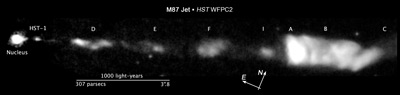
Image : This sequence of images, taken over a 13-year span by NASA's Hubble Space Telescope, reveals changes in a black-hole-powered jet of hot gas in the giant elliptical galaxy M87.

The observations show that the river of plasma, traveling at nearly the speed of light, may follow the spiral structure of the black hole's magnetic field, which astronomers think is coiled like a helix. The magnetic field is believed to arise from a spinning accretion disk of material around a black hole. Although the magnetic field cannot be seen, its presence is inferred by the confinement of the jet along a narrow cone emanating from the black hole. The visible portion of the jet extends 5,000 light-years.


M87 resides at the center of the neighboring Virgo cluster of roughly 2,000 galaxies, located 50 million light-years away.

The images are part of a time-lapse movie that reveals changes in the jet over more than a 13-year period. They were taken by Hubble's Advanced Camera for Surveys in 2006 and Wide Field Planetary Camera 2 in 1995, 1998, 2001, and 2007.
More than thirteen years of observations from NASA's Hubble Space Telescope have allowed astronomers to assemble time-lapse movies of a 5,000-light-year-long jet of superheated gas being ejected from a supermassive black hole in the center of the giant elliptical galaxy M87.

The movies promise to give astronomers a better understanding of how active black holes shape galaxy evolution. While matter drawn completely into a black hole cannot escape its enormous gravitational pull, most infalling material drawn toward it first joins an orbiting region known as an accretion disk encircling the black hole. Magnetic fields surrounding the black hole are thought to entrain some of this ionized gas, ejecting it as very high-velocity jets.

"Central supermassive black holes are a key component in all big galaxies," said Eileen T. Meyer of the Space Telescope Science Institute (STScI) in Baltimore, Md., the Hubble study's lead author. "Most of these black holes are believed to have gone through an active phase, and black-hole-powered jets from this active phase play a key role in the evolution of galaxies. By studying the details of this process in the nearest galaxy with an optical jet, we can hope to learn more about galaxy formation and black hole physics in general."

The Hubble movies reveal for the first time that the jet's river of plasma travels in a spiral motion. This motion is considered strong evidence that the plasma may be traveling along a magnetic field, which the team thinks is coiled like a helix. The magnetic field is believed to arise from a spinning accretion disk of material around a black hole. Although the magnetic field cannot be seen, its presence is inferred by the confinement of the jet along a narrow cone emanating from the black hole.

"We analyzed several years' worth of Hubble data of a relatively nearby jet, which allowed us to see lots of details," Meyer said. "The only reason you see the distant jet in motion at all over just a few years is because it is traveling very fast."

Meyer found evidence for the magnetic field's suspected helical structure in several locations along the jet. In the outer part of the M87 jet, for example, one bright gas clump, called knot B, appears to zigzag, as if it were moving along a spiral path. Several other gas clumps along the jet also appear to loop around an invisible structure. "Past observations of black hole jets couldn't distinguish between radial motion and side-to-side motion, so they didn't provide us with detailed information of the jet's behavior," Meyer explained.

Compass and Scale Image for M87 Jet
M87 resides at the center of the neighboring Virgo cluster of roughly 2,000 galaxies, located 50 million light-years away. The galaxy's monster black hole is several billion times more massive than our Sun.

Image :The accretion disk of hot plasma swirling around a supermassive black hole generates powerful magnetic fields. The disk's rotation twists the field into a funnel shape. These field lines constrict and direct the outflow of high-speed plasma from the black hole's vicinity. The result is a narrow, tapered, extragalactic jet. 

In addition, the Hubble data provided information on why the jet is composed of a long string of gas blobs, which appear to brighten and dim over time.

"The jet structure is very clumpy. Is this a ballistic effect, like cannonballs fired sequentially from a cannon?" Meyer asked. "Or, is there some particularly interesting physics going on, such as a shock that is magnetically driven?"

Meyer's team found evidence for both scenarios. "We found things that move quickly," Meyer said. "We found things that move slowly. And, we found things that are stationary. This study shows us that the clumps are very dynamic sources."

The research team spent eight months analyzing 400 observations from Hubble's Wide Field Planetary Camera 2 and Advanced Camera for Surveys. The observations were taken from 1995 to 2008. Several team members, however, have been observing M87 for 20 years. Only Hubble's sharp vision allowed the research team to measure the jet's slight motion in the sky over 13 years. Meyer's team also measured features in the hot plasma as small as 20 light-years wide.

It's too soon to tell whether all black-hole-powered jets behave like the one in M87. That's why Meyer plans to use Hubble to study three more jets. "It's always dangerous to have exactly one example because it could be a strange outlier," Meyer said. "The M87 black hole is justification for looking at more jets."

The team's results will appear Aug. 22 in the online issue of The Astrophysical Journal Letters.

In addition to Eileen Meyer, other members of the science team are William Sparks, John Biretta, Jay Anderson, Sangmo Tony Sohn, and Roeland van der Marel of STScI; Colin Norman of Johns Hopkins University, Baltimore, Md.; and Masanori Nakamura of Academia Sinica, Taipei, Taiwan.

Source : Hubblesite
By Science and Universe

New theory points to ‘zombie vortices’ as key step in star formation

Add Comment
Artist concept of a brown dwarf, spotted by NASA's Spitzer Space Telescope, surrounded by a spinning protoplanetary disk. UC Berkeley researchers have developed a model that shows how vortices help destabilize the disk so that gas can spiral inward toward a forming star. (Image courtesy of NASA/JPL-Caltech)

A new theory by fluid dynamics experts at the University of California, Berkeley, shows how “zombie vortices” help lead to the birth of a new star. 
Reporting today (Tuesday, Aug. 20) in the journal Physical Review Letters, a team led by computational physicist Philip Marcus shows how variations in gas density lead to instability, which then generates the whirlpool-like vortices needed for stars to form.
Illustration of the near stellar environment of the star Beta Pictoris. This image is based upon observations made with the Goddard High Resolution Spectrograph aboard the Hubble Space Telescope. (Image by Dana Berry, Space Telescope Science Institute)
Astronomers accept that in the first steps of a new star’s birth, dense clouds of gas collapse into clumps that, with the aid of angular momentum, spin into one or more Frisbee-like disks where a protostar starts to form. But for the protostar to grow bigger, the spinning disk needs to lose some of its angular momentum so that the gas can slow down and spiral inward onto the protostar. Once the protostar gains enough mass, it can kick off nuclear fusion.
“After this last step, a star is born,” said Marcus, a professor in the Department of Mechanical Engineering.
What has been hazy is exactly how the cloud disk sheds its angular momentum so mass can feed into the protostar.
Destabilizing forces
The leading theory in astronomy relies on magnetic fields as the destabilizing force that slows down the disks. One problem in the theory has been that gas needs to be ionized, or charged with a free electron, in order to interact with a magnetic field. However, there are regions in a protoplanetary disk that are too cold for ionization to occur.
“Current models show that because the gas in the disk is too cool to interact with magnetic fields, the disk is very stable,” said Marcus. “Many regions are so stable that astronomers call them dead zones – so it has been unclear how disk matter destabilizes and collapses onto the star.”
The researchers said current models also fail to account for changes in a protoplanetary disk’s gas density based upon its height.
“This change in density creates the opening for violent instability,” said study co-author Pedram Hassanzadeh, who did this work as a UC Berkeley Ph.D. student in mechanical engineering. When they accounted for density change in their computer models, 3-D vortices emerged in the protoplanetary disk, and those vortices spawned more vortices, leading to the eventual disruption of the protoplanetary disk’s angular momentum.
“Because the vortices arise from these dead zones, and because new generations of giant vortices march across these dead zones, we affectionately refer to them as ‘zombie vortices,’” said Marcus. “Zombie vortices destabilize the orbiting gas, which allows it to fall onto the protostar and complete its formation.”
The researchers note that changes in the vertical density of a liquid or gas occur throughout nature, from the oceans – where water near the bottom is colder, saltier and denser than water near the surface – to our atmosphere, where air is thinner at higher altitudes. These density changes often create instabilities that result in turbulence and vortices such as whirlpools, hurricanes and tornadoes. Jupiter’s variable-density atmosphere hosts numerous vortices, including its famous Great Red Spot.
Illustration of a protoplanetary disk based upon observations from the Keck II telescope. (Image courtesy of W. M. Keck Observatory)
Connecting the steps leading to a star’s birth
This new model has caught the attention of Marcus’s colleagues at UC Berkeley, including Richard Klein, adjunct professor of astronomy and a theoretical astrophysicist at the Lawrence Livermore National Laboratory. Klein and fellow star formation expert Christopher McKee, UC Berkeley professor of physics and astronomy, were not part of the work described in Physical Review Letters, but are collaborating with Marcus to put the zombie vortices through more tests.
Klein and McKee have worked over the last decade to calculate the crucial first steps of star formation, which describes the collapse of giant gas clouds into Frisbee-like disks. They will collaborate with Marcus’s team by providing them with their computed velocities, temperatures and densities of the disks that surround protostars. This collaboration will allow Marcus’s team to study the formation and march of zombie vortices in a more realistic model of the disk.
By Science and Universe

ALMA Takes Close Look at Drama of Starbirth

Add Comment

Starbirth Surprisingly Energetic: New Insights Into Protostars

Stunning ALMA and NTT image of Newborn Star
 Astronomers using the Atacama Large Millimeter/submillimeter Array (ALMA) have obtained a vivid close-up view of material streaming away from a newborn star. By looking at the glow coming from carbon monoxide molecules in an object called Herbig-Haro 46/47 they have discovered that its jets are even more energetic than previously thought. The very detailed new images have also revealed a previously unknown jet pointing in a totally different direction.

Young stars are violent objects that eject material at speeds as high as one million kilometres per hour. When this material crashes into the surrounding gas it glows, creating a Herbig-Haro object . A spectacular example is named Herbig-Haro 46/47 and is situated about 1400 light-years from Earth in the southern constellation of Vela (The Sails). This object was the target of a study using ALMA during the Early Science phase, whilst the telescope was still under construction and well before the array was completed.

ALMA’s view of the outflow associated
with the Herbig-Haro object HH 46/47
The new images reveal fine detail in two jets, one coming towards Earth and one moving away. The receding jet was almost invisible in earlier pictures made in visible light, due to obscuration by the dust clouds surrounding the new-born star. ALMA has not only provided much sharper images than earlier facilities but also allowed astronomers to measure how fast the glowing material is moving through space.

These new observations of Herbig-Haro 46/47 revealed that some of the ejected material had velocities much higher than had been measured before. This means the outflowing gas carries much more energy and momentum than previously thought.

The team leader and first author of the new study, Héctor Arce (Yale University, USA) explains that "ALMA's exquisite sensitivity allows the detection of previously unseen features in this source, like this very fast outflow. It also seems to be a textbook example of a simple model where the molecular outflow is generated by a wide-angle wind from the young star."

The Herbig-Haro object HH 46/47 seen
 with ESO’s New Technology Telescope
 The observations were obtained in just five hours of ALMA observation time – even though ALMA was still under construction at the time – similar quality observations with other telescopes would have taken ten times longer.

"The detail in the Herbig-Haro 46/47 images is stunning. Perhaps more stunning is the fact that, for these types of observations, we really are still in the early days. In the future ALMA will provide even better images than this in a fraction of the time," adds Stuartt Corder (Joint ALMA Observatory, Chile), a co-author on the new paper.

Diego Mardones (Universidad de Chile), another co-author, emphasises that "this system is similar to most isolated low mass stars during their formation and birth. But it is also unusual because the outflow impacts the cloud directly on one side of the young star and escapes out of the cloud on the other. This makes it an excellent system for studying the impact of the stellar winds on the parent cloud from which the young star is formed."

Wide-field view of the star-forming region around the Herbig-Haro object HH 46/47
The sharpness and sensitivity achieved by these ALMA observations also allowed the team to discover an unsuspected outflow component that seems to be coming from a lower mass companion to the young star. This secondary outflow is seen almost at right angles to the principal object and is apparently carving its own hole out of the surrounding cloud.

The Herbig-Haro object HH 46/47 in the constellation of Vela

Arce concludes that "ALMA has made it possible to detect features in the observed outflow much more clearly than previous studies. This shows that there will certainly be many surprises and fascinating discoveries to be made with the full array. ALMA will certainly revolutionise the field of star formation!"

By Science and universe

Dwarf Galaxy Caught Ramming Into a Large Spiral

Add Comment
Observations with Chandra have revealed a giant
cloud of superheated gas in a galaxy 
about 60 
million light years from Earth. 
(Credit: X-ray: 
NASA/CXC/Huntingdon Inst. for 
X-ray 
Astronomy/G.Garmire, Optical: ESO/VLT)
Observations with NASA's Chandra X-ray Observatory have revealed a massive cloud of multimillion-degree gas in a galaxy about 60 million light years from Earth. The hot gas cloud is likely caused by a collision between a dwarf galaxy and a much larger galaxy called NGC 1232. If confirmed, this discovery would mark the first time such a collision has been detected only in X-rays, and could have implications for understanding how galaxies grow through similar collisions.

An image combining X-rays and optical light shows the scene of this collision. The impact between the dwarf galaxy and the spiral galaxy caused a shock wave − akin to a sonic boom on Earth -- that generated hot gas with a temperature of about 6 million degrees. Chandra X-ray data, in purple, show the hot gas has a comet-like appearance, caused by the motion of the dwarf galaxy. Optical data from the European Southern Observatory's Very Large Telescope reveal the spiral galaxy in blue and white. X-ray point sources have been removed from this image to emphasize the diffuse emission.

Near the head of the comet-shaped X-ray emission (mouse over the image for the location) is a region containing several very optically bright stars and enhanced X-ray emission. Star formation may have been triggered by the shock wave, producing bright, massive stars. In that case X-ray emission would be generated by massive star winds and by the remains of supernova explosions as massive stars evolve.

The mass of the entire gas cloud is uncertain because it cannot be determined from the two-dimensional image whether the hot gas is concentrated in a thin pancake or distributed over a large, spherical region. If the gas is a pancake, the mass is equivalent to forty thousand Suns. If it is spread out uniformly, the mass could be much larger, about three million times as massive as the Sun. This range agrees with values for dwarf galaxies in the Local Group containing the Milky Way.

The hot gas should continue to glow in X-rays for tens to hundreds of millions of years, depending on the geometry of the collision. The collision itself should last for about 50 million years. Therefore, searching for large regions of hot gas in galaxies might be a way to estimate the frequency of collisions with dwarf galaxies and to understand how important such events are to galaxy growth.

An alternative explanation of the X-ray emission is that the hot gas cloud could have been produced by supernovas and hot winds from large numbers of massive stars, all located on one side of the galaxy. The lack of evidence of expected radio, infrared, or optical features argues against this possibility.

Article Source : Chandra X-ray Observatory.
by Science and Universe

Hanny's Voorwerp

Add Comment
Click here for Image Details
One of the strangest space objects ever seen is being scrutinized by the penetrating vision of NASA's Hubble Space Telescope. A mysterious, glowing green blob of gas is floating in space near a spiral galaxy. Hubble uncovered delicate filaments of gas and a pocket of young star clusters in the giant object, which is the size of our Milky Way galaxy.

The Hubble revelations are the latest finds in an ongoing probe of Hanny's Voorwerp (Hanny's Object in Dutch), named for Hanny van Arkel, the Dutch teacher who discovered the ghostly structure in 2007 while participating in the online Galaxy Zoo project. Galaxy Zoo enlists the public to help classify more than a million galaxies catalogued in the Sloan Digital Sky Survey. The project has expanded to include the Hubble Zoo, in which the public is asked to assess tens of thousands of galaxies in deep imagery from the Hubble Space Telescope.

In the sharpest view yet of Hanny's Voorwerp, Hubble's Wide Field Camera 3 and Advanced Camera for Surveys have uncovered star birth in a region of the green object that faces the spiral galaxy IC 2497, located about 650 million light-years from Earth. Radio observations have shown an outflow of gas arising from the galaxy's core. The new Hubble images reveal that the galaxy's gas is interacting with a small region of Hanny's Voorwerp, which is collapsing and forming stars. The youngest stars are a couple of million years old.

"The star clusters are localized, confined to an area that is over a few thousand light-years wide," explains astronomer William Keel of the University of Alabama in Tuscaloosa, leader of the Hubble study. "The region may have been churning out stars for several million years. They are so dim that they have previously been lost in the brilliant light of the surrounding gas."

Hubble Infrared Image of Area Surrounding Hanny's Voorwerp

Recent X-ray observations have revealed why Hanny's Voorwerp caught the eye of astronomers. The galaxy's rambunctious core produced a quasar, a powerful light beacon powered by a black hole. The quasar shot a broad beam of light in Hanny's Voorwerp's direction, illuminating the gas cloud and making it a space oddity. Its bright green color is from glowing oxygen.

"We just missed catching the quasar, because it turned off no more than 200,000 years ago, so what we're seeing is the afterglow from the quasar," Keel says. "This implies that it might flicker on and off, which is typical of quasars, but we've never seen such a dramatic change happen so rapidly."

The quasar's outburst also may have cast a shadow on the blob. This feature gives the illusion of a gaping hole about 20,000 light-years wide in Hanny's Voorwerp. Hubble reveals sharp edges around the apparent opening, suggesting that an object close to the quasar may have blocked some of the light and projected a shadow on Hanny's Voorwerp. This phenomenon is similar to a fly on a movie projector lens casting a shadow on a movie screen.

Hanny's Voorwerp -- A Space Oddity
Radio studies have revealed that Hanny's Voorwerp is not just an island gas cloud floating in space. The glowing blob is part of a long, twisting rope of gas, or tidal tail, about 300,000 light-years long that wraps around the galaxy. The only optically visible part of the rope is Hanny's Voorwerp. The illuminated object is so huge that it stretches from 44,000 light-years to 136,000 light-years from the galaxy's core.

The quasar, the outflow of gas that instigated the star birth, and the long, gaseous tidal tail point to a rough life for IC 2497.

"The evidence suggests that IC 2497 may have merged with another galaxy about a billion years ago," Keel explains. "The Hubble images show in exquisite detail that the spiral arms are twisted, so the galaxy hasn't completely settled down."

In Keel's scenario, the merger expelled the long streamer of gas from the galaxy and funneled gas and stars into the center, which fed the black hole. The engorged black hole then powered the quasar, which launched two cones of light. One light beam illuminated part of the tidal tail, now called Hanny's Voorwerp.

About a million years ago, shock waves produced glowing gas near the galaxy's core and blasted it outward. The glowing gas is seen only in Hubble images and spectra, Keel says. The outburst may have triggered star formation in Hanny's Voorwerp. Less than 200,000 years ago, the quasar dropped in brightness by 100 times or more, leaving an ordinary-looking core.

New images of the galaxy's dusty core from Hubble's Space Telescope Imaging Spectrograph show an expanding bubble of gas blown out of one side of the core, perhaps evidence of the sputtering quasar's final gasps. The expanding ring of gas is still too small for ground-based telescopes to detect.

"This quasar may have been active for a few million years, which perhaps indicates that quasars blink on and off on timescales of millions of years, not the 100 million years that theory had suggested," Keel says. He added that the quasar could light up again if more material is dumped around the black hole.

Source : Hubble Site
By Science and Universe